Meta Ads Payment Declined? How To Fix When Your Bank Card Keeps Failed?
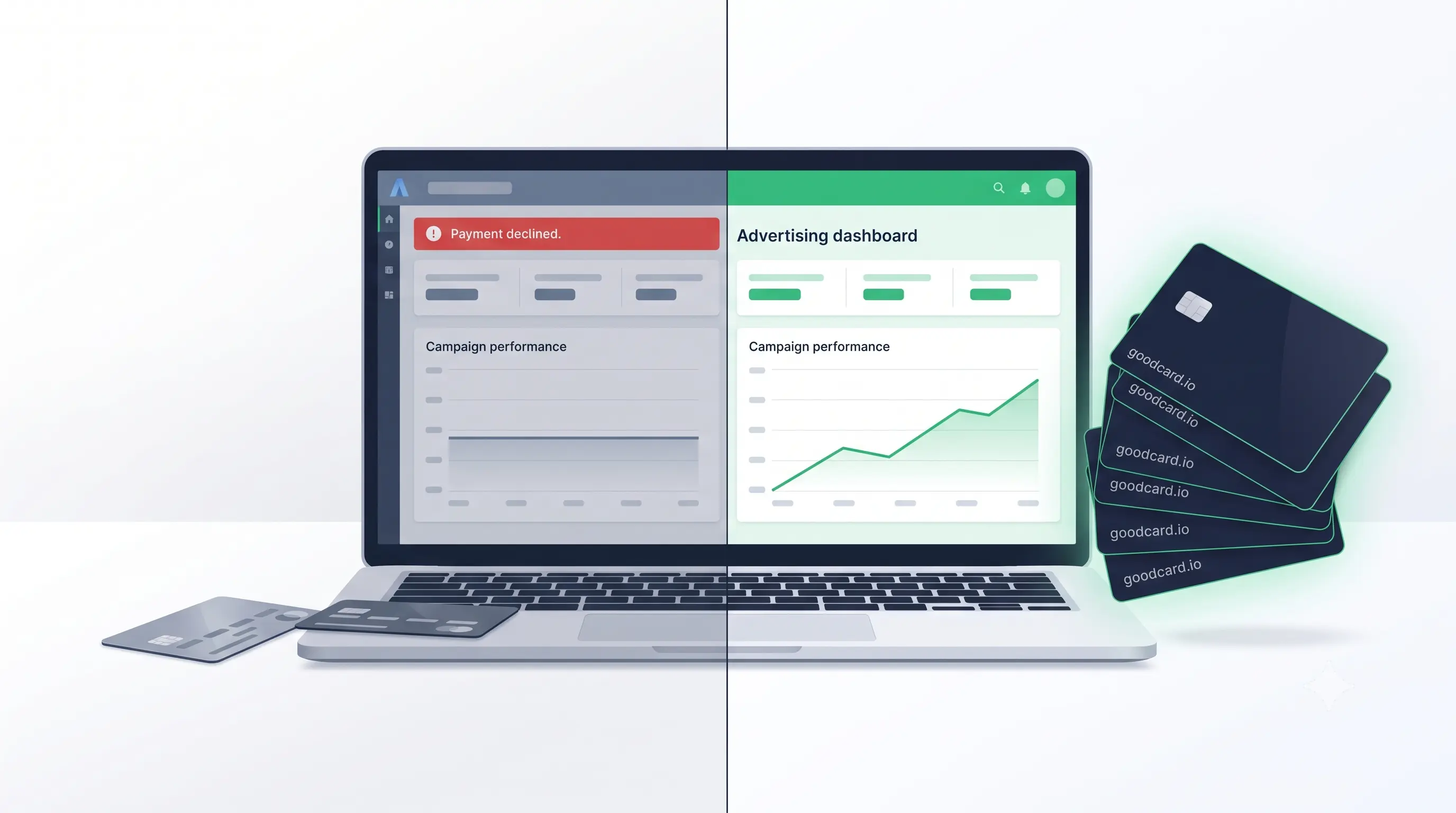
Your Meta Ads charge fails with no warning and no explanation — campaigns stop delivering overnight. You call your bank and they say Meta blocked it; you open a Meta ticket and they say your bank declined it. Both sides point at each other, nobody gives you an answer, and your campaigns are still down.
Why bank cards fail on Meta Ads?
A decline on Meta Ads is almost never one dramatic block. It's usually one of several quiet risk rules firing on a card that was never designed for cross-border advertising spend in the first place.
1. Your BIN isn't built for ad platform billing
The first six to eight digits of your card — the BIN — tell Meta's payment processor which institution issued the card, in which country, under what product type (debit, credit, prepaid, commercial), and with what typical risk profile.
Some BINs have a long, clean history with recurring international ad platform billing. Others don't. If your BIN is mostly used for domestic retail purchases and rarely appears in cross-border digital advertising, the authorization gets scored as unusual. Meta's processor may soft-decline it. Your bank may flag it too. Neither system tells you the BIN is the reason, because neither system is designed to explain itself to you.
2. The billing pattern looks like fraud to your bank
Meta doesn't charge you like a normal merchant. It charges when you hit your billing threshold — which means small charges, then larger ones, then multiple charges in a single day as your spend accelerates.
To a retail bank's fraud engine, that pattern is textbook card testing: repeated variable-amount charges from a foreign merchant, escalating in frequency. Their model doesn't know you're scaling a winning campaign. It sees velocity anomaly and blocks the card.
3. 3D Secure challenges you never see
Many banks now require 3D Secure verification on international transactions. But Meta bills you automatically in the background — you're not sitting at a checkout page waiting to approve anything. When the authentication challenge can't be completed, the charge simply fails. Silently.
4. Cross-border and currency friction
If your account bills in USD and your card settles in local currency, you're adding conversion fees, cross-border fees, and an extra layer of issuer rules that can reject the transaction outright — particularly if your card has any restriction on foreign online merchants.
Why support can't help you
Meta's support team can see that an authorization was attempted and returned a decline code. They usually can't see why your issuer returned it. Your bank's frontline support can see a blocked transaction, but the risk rules that blocked it live in an automated system they don't have visibility into or authority over.
Neither side is lying to you. Both are genuinely limited. Which is exactly why chasing an explanation is a waste of your time — and why the fix has to come from changing what you pay with.
The second problem: you can't scale on one or two cards
Even when your bank card works, it caps how big you can get.
Most banks will issue you one primary card and maybe a secondary. That's fine for a personal Netflix subscription. It's a hard ceiling if you're running serious ad volume.
Your daily and monthly limits weren't set for ad spend. As soon as your campaigns start performing and you want to push budget, you hit an internal limit that has nothing to do with your actual balance. Increasing it means a request, a review, and a wait — while your competitor takes the auction.
Your bank starts treating growth as risk. Ironically, the better your campaigns perform, the more suspicious your spend pattern looks. Rising international charges to the same merchant trigger review. Some businesses find their card frozen precisely at the moment they're scaling fastest.
One card across many ad accounts creates linkage. This is the one that hurts most. When you run multiple ad accounts — separate brands, separate clients, separate regions — and you attach the same payment method to all of them, that shared card becomes a connective thread between accounts. If one account gets flagged for a policy issue, that link can pull the others into review with it. Agencies discover this the hard way: one account gets restricted on Monday, and by Wednesday five more are limited too.
You didn't do anything wrong. You just didn't have enough cards to keep accounts cleanly separated.
What changes with GoodCard
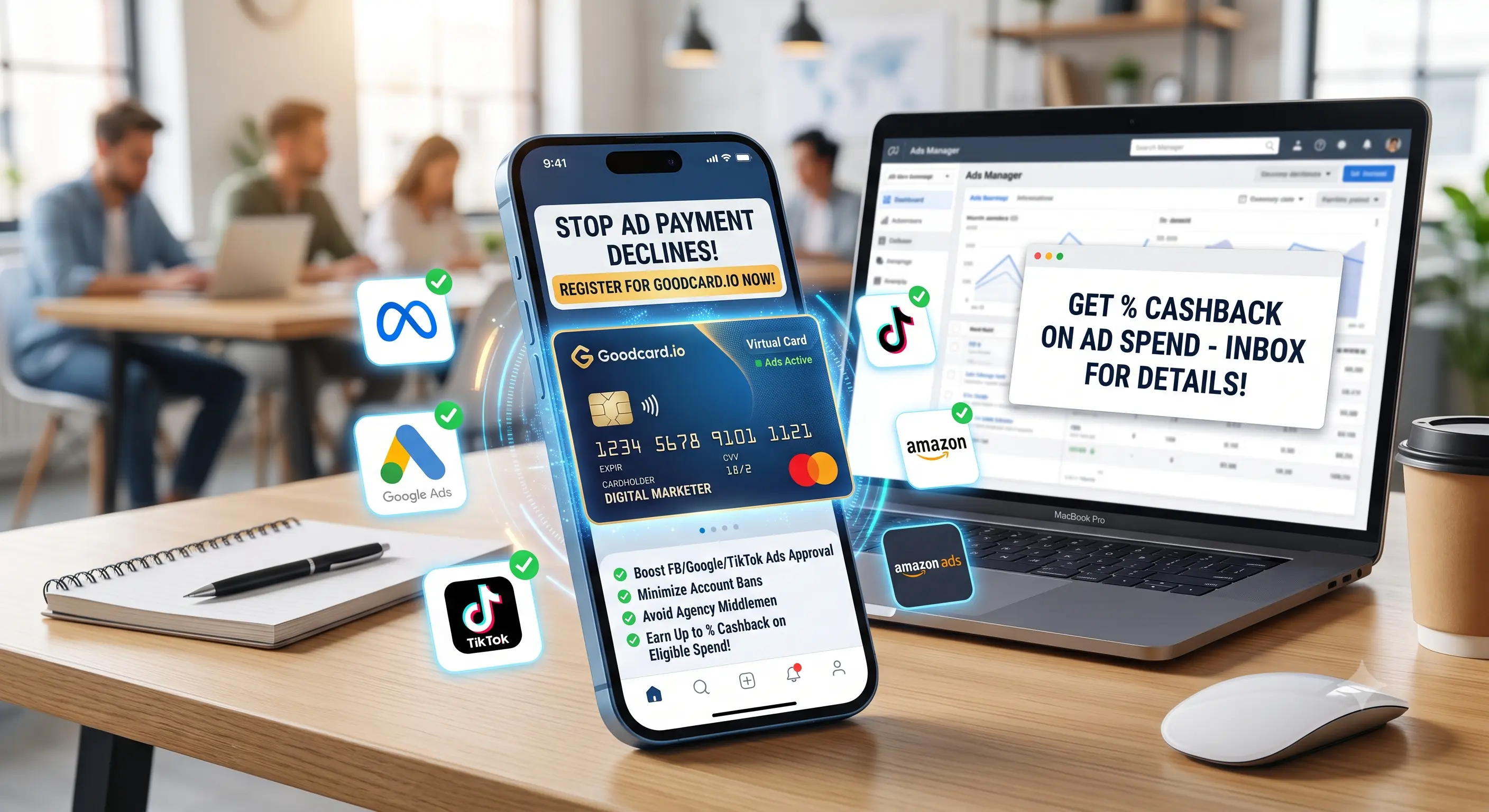
GoodCard is built for exactly this use case: paying ad platforms and online business expenses without the fragility of a retail bank card.
BIN ranges that work for advertising
GoodCard issues cards on BIN ranges suited to both business and individual advertisers, selected specifically for compatibility with international ad platform billing. That's the difference between a card that gets scored as an unusual foreign transaction and one that processes as a routine, expected charge.
This isn't a workaround. It's using the right financial product for the job — the same way you wouldn't run a business payroll through a personal savings account.
Open as many cards as you actually need
Instead of being rationed one or two cards by a bank, you issue cards from a dashboard, on demand, in minutes.
That unlocks the operating model serious advertisers actually want:
- One card per ad account. No shared payment method linking accounts that should stay independent.
- One card per client. Agencies can attribute every dollar to the right client with zero reconciliation guesswork at month end.
- One card per campaign or channel. Meta on one, Google on another, TikTok on a third — spend reporting sorts itself.
- Backup cards ready to go. If one card ever has an issue, you swap payment methods in thirty seconds instead of losing a day of delivery.
You're no longer one card away from your entire operation stopping.
Scale without asking permission
Because you're funding a balance and distributing it across cards you control, growing your spend isn't a negotiation with a risk department. You allocate limits per card yourself, adjust them when a campaign proves out, and freeze anything that isn't needed. Budget control moves from your bank's system into yours.
Cashback on ad spend — and beyond
Every dollar you push through Meta is already a cost. With GoodCard, qualifying spend earns cashback — and not just on advertising. Eligible online business spending qualifies too: SaaS subscriptions, hosting, design tools, analytics platforms, and the other recurring costs that quietly accumulate every month.
At meaningful ad volume, cashback stops being a nice-to-have. On a monthly six-figure ad budget, a percentage back is a real line item in your margin — money that would otherwise have gone nowhere. Rates vary by category and account tier, and you can see exactly what you've earned in your dashboard rather than deciphering a statement three weeks later.
Transparent card and spend management
Every card, every transaction, every balance, in one place and in real time.
- See exactly which card was charged, when, by which platform
- Set and adjust per-card spending limits instantly
- Freeze or close any card immediately, without a phone call
- Track spend by client, campaign, or team member without manual tagging
- Export clean records for accounting instead of reconstructing them from bank statements
When a charge fails — which will happen far less often — you can see it in your dashboard immediately, instead of finding out when your campaign has already stopped delivering.
Frequently asked questions
1. How fast can I get a card? Once your account is verified, new virtual cards are issued from the dashboard in minutes. No waiting for physical delivery.
2. Can I use one card for multiple ad accounts? You can — but you generally shouldn't. Issuing a separate card per ad account is the main reason to use GoodCard in the first place: it keeps accounts cleanly separated and avoids the linkage that causes cascading restrictions.
3. Does this work for individuals, or only registered companies? Both. GoodCard supports BIN options suited to business entities as well as individual advertisers, so freelancers and solo operators aren't locked out.
4. What happens if a charge still fails? You'll see it in your dashboard in real time, with the reason available — and you can switch the ad account to a backup card immediately rather than waiting on support tickets from two directions.
5. Which platforms does it work with? Meta Ads, Google Ads, TikTok Ads, and standard online merchants — anywhere a Visa or Mastercard is accepted for legitimate business spend.
Stop losing campaigns to payment problems
Every failed charge costs more than the transaction. It costs the delivery you lost, the learning phase you have to restart, the auction position you gave away, and the hours you spent on hold with a bank that couldn't tell you anything useful.
You can keep escalating tickets between Meta and your bank. Or you can pay with a card built for this.
Open your GoodCard account — issue multiple virtual cards with advertising-ready BINs, scale your ad spend without artificial limits, and earn cashback on money you were already spending.